what are the effects of shooting firearms to blood pressure
June 07, 2018
When a cartridge is fired, a progressive burn of the propellant converts information technology to quickly expanding gas that exerts an equal amount of pressure level in all directions. Maximum recommended pressure level for a rifle cartridge is usually dictated past the action forcefulness of the rifle for which information technology is developed.
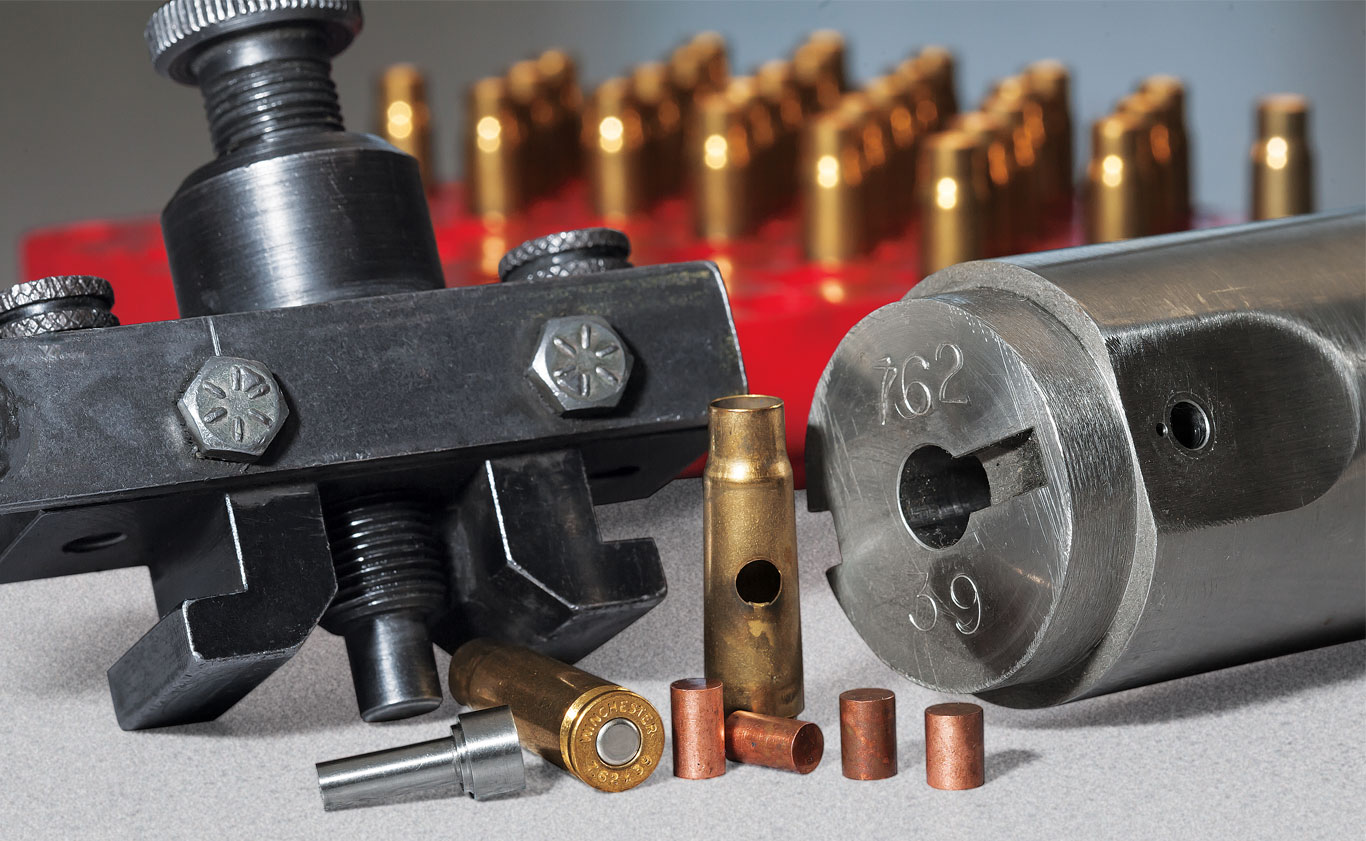
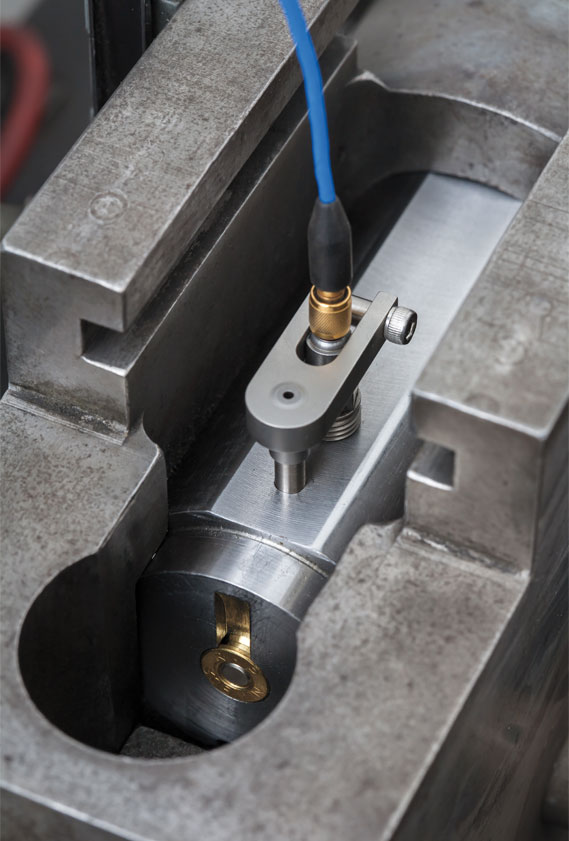
For many years the copper crusher method was used throughout the shooting industry for determining chamber pressure, and you can see some of the equipment required in the pb photograph accompanying this article. A minor copper cylinder of predetermined compressibility is placed into a yoke device that is clamped to the butt in its chamber surface area, where pressure is highest.
One end of a piston is positioned through a hole drilled through the wall of the barrel. Its opposite finish is against a copper cylinder while the other finish of the cylinder rests against a stationary anvil. When a round is fired, force per unit area exerted against the piston "crushes" or shortens the cylinder. The higher the pressure the shorter the cylinder becomes. Subsequently the cylinder is removed, its length is measured with a micrometer and the amount of compression is converted to copper units of force per unit area (c.u.p.) past comparing the length to a tarage nautical chart provided past the manufacturer of each lot of cylinders.
Today, almost of the industry has converted to the piezoelectric transducer and uses the common pounds per square inch (psi) as its unit of measure. While the initial investment for the transducer is more expensive than a copper crusher system, it is quicker to use and provides more than accurate information.
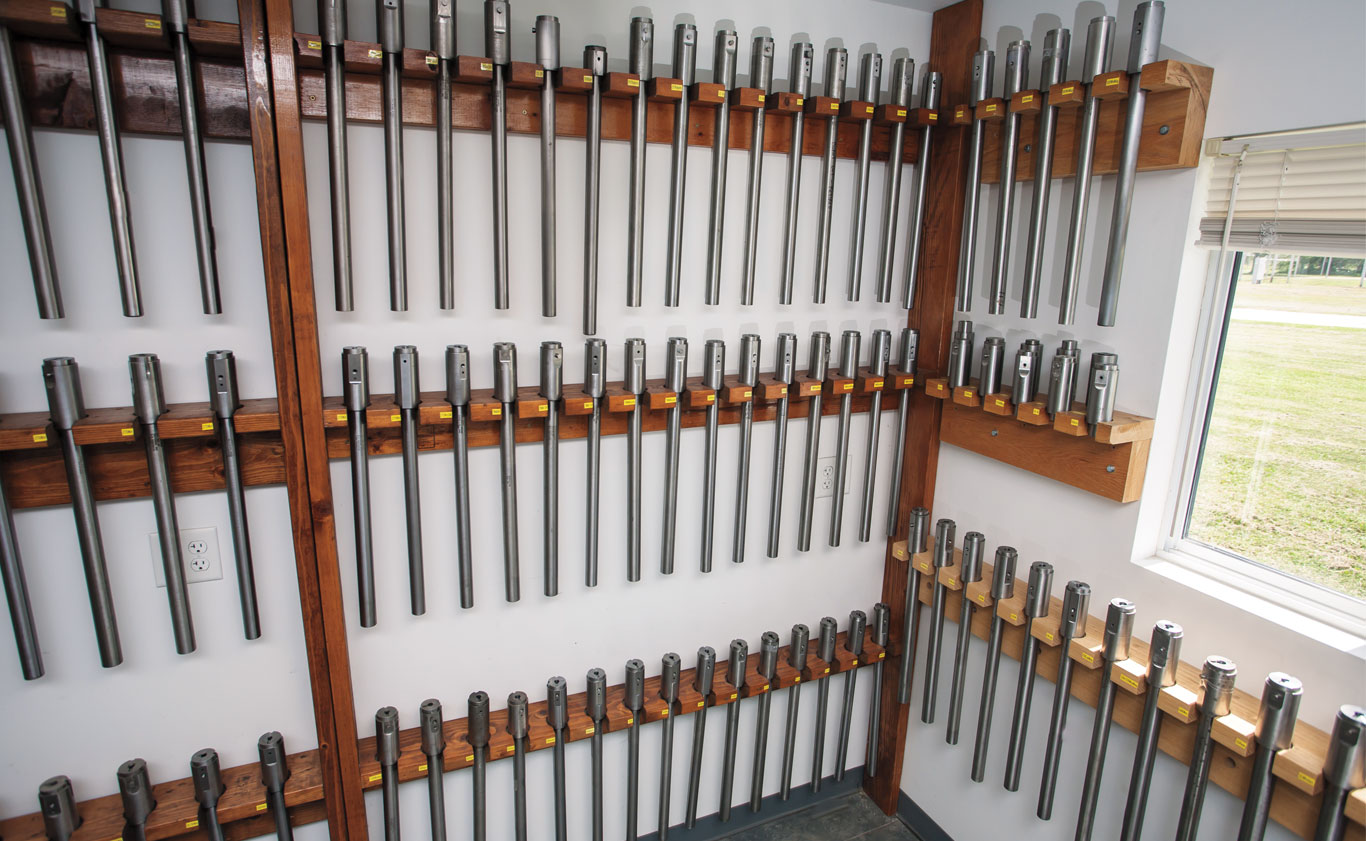
In this process, a hole is drilled through the chamber wall of a barrel and threaded. A metal plug with a nose profile matching the curvature of the chamber is then screwed into the barrel. The business cease of the plug conforms to the shape of the sleeping accommodation wall.
When a cartridge fires, pressure exerted on the transducer by the wall of the case is transferred to a special crystal that responds to mechanical force by generating an electrical charge in direct proportion to the applied strength. Computer software converts the bespeak to psi.
The .30-thirty Win. originated in 1895 and was adult for the rear-locking Winchester Model 94. It is loaded to a maximum of 42,000 psi. The .270 Win. came along 30 years later, and because information technology was adult for the much stronger action of the Winchester Model 54, its maximum force per unit area was fix at 65,000 psi.
While the same amount of pressure is exerted in all directions during firing, actual pressure exerted is determined by surface expanse. To simplify by exaggeration, permit's say the base surface area of a bullet is i inch. If the powder in the cartridge that bullet is fired from generates 50,000 psi, the bullet is kicked in the rump by 50,000 psi of pressure. Merely if base of operations area is reduced to one-half inch, force per unit area exerted on the bullet is reduced to 25,000 psi.
When the same corporeality of force per unit area is exerted against 150-grain bullets in the .thirty-06 and .270 Win., velocity volition be a bit higher for the .30-06 for two reasons. Its larger base of operations diameter gives propellant gas a larger surface expanse to push against and a shorter bearing surface makes it a flake less resistant to being pushed downward the bore of a barrel.
Moving to the opposite finish of a rifle action, an increase in the head surface area of a cartridge results in an increase in pressure level exerted on the breech-locking organization of the activeness and vice versa.
Maximum recommended sleeping accommodation force per unit area for the Model 1898 Krag in .thirty-40 quotient is forty,000 c.u.p. I have a handsome custom rifle on the Krag action built by Griffin & Howe during the 1930s, and it is chambered to .22 Hornet, which is unremarkably loaded to 47,000 c.u.p. That rifle never complains because, due to its considerably smaller caput surface area, the .22 Hornet exerts simply about half the pressure confronting the face of the bolt when both cartridges are loaded to their maximums. If a .30-forty cartridge loaded to the aforementioned pressure as the .22 Hornet were fired, both rifle and shooter would likely get very unhappy.
Back-thrust level is actually non that cutting and stale. If the chamber is coated with oil, or if resizing lube is left on the case of a handloaded cartridge, all the pressure its caput area can exert will exist applied. But if neither of those is present, pressure during firing forces the wall of the case against the bedroom wall firmly enough to prevent the example from moving to the rear.
At that point in fourth dimension, the shoulder of the case is bearing hard on the shoulder of the chamber, and due to a small-scale gap between the head of the cartridge and the face of the commodities, the instance just forward of its extractor groove will stretch enough to allow its rear department to move rearward to fill the infinite. And while some pressure level is exerted against the bolt, information technology is a small percentage of the total amount.
The corporeality of pressure exerted against the locking bolt is also influenced by the shape of a cartridge case. All else being the same, a case with minimum torso taper - the .300 Win. Magazine. for example - exerts less dorsum-thrust than the .300 H&H Magazine. with its considerable taper. This is neither here nor there for forepart-locking, commodities-action rifles because they are designed to handle far more back-thrust than either of those cartridges delivers when they are loaded to their established maximums. Simply it tin can matter in rear-locking actions due to momentary commodities compression and receiver stretch.
The higher the pressure, the more the bolt compresses and the receiver stretches, but as long as their force limits are not exceeded, elasticity in steel causes them to bound back to their original dimensions.
Years ago, I traded for a Marlin 336 and decided to rebarrel it for the 7mm STE mutiny I was working on, which is based on the .307 Win. case. At starting time I did zip more than cervix downward the .307 Win. example to 7mm. But in working up loads, I experienced sticky extraction prior to reaching expected velocities and well below reaching maximum pressures.
Then I recalled 1 of many experiments described past P.O. Ackley in his ii-book Handbook for Shooters & Reloaders. He had rechambered a Winchester Model 94 for his .xxx-30 Improved, and the wall of the case gripped the wall of the chamber then tightly the rifle could exist fired with locking bolt removed. Do non try this! The indicate is, past only changing the shape of the cartridge - in this case, reducing body taper - he significantly lowered cartridge dorsum-thrust.
With that in mind, I proceeded to blow out (better) the .307 instance for less body taper. With the respective reduction in dorsum-thrust, I was able to reach my velocity goals with no extraction trouble and at slightly less pressure level than the .307 Win. is ordinarily loaded to 52,000 c.u.p., a level shared by the .307 Win. and the original chambering of my Marlin (.356 Win.)
I accomplished 2,900 fps with a 120-grain Nosler and ii,700 fps with a 139-grain Hornady. Those loads for the cartridge were published in the 26th edition of Hodgdon's reloading manual.
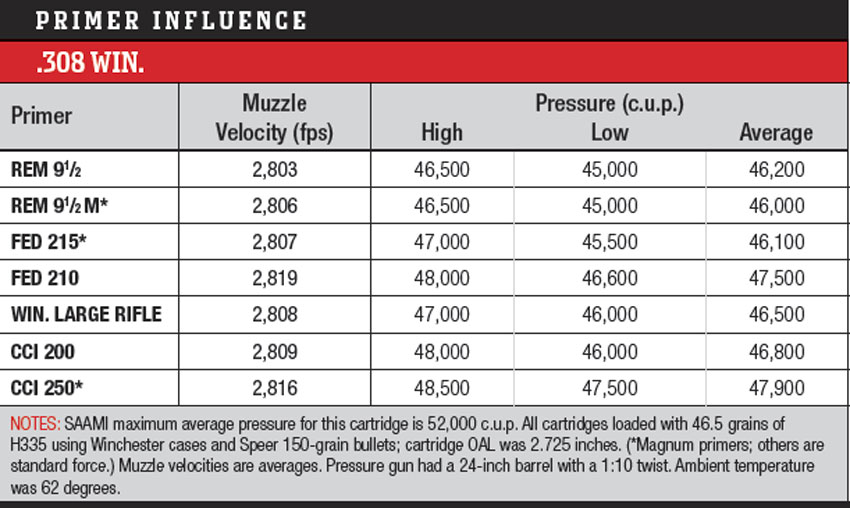
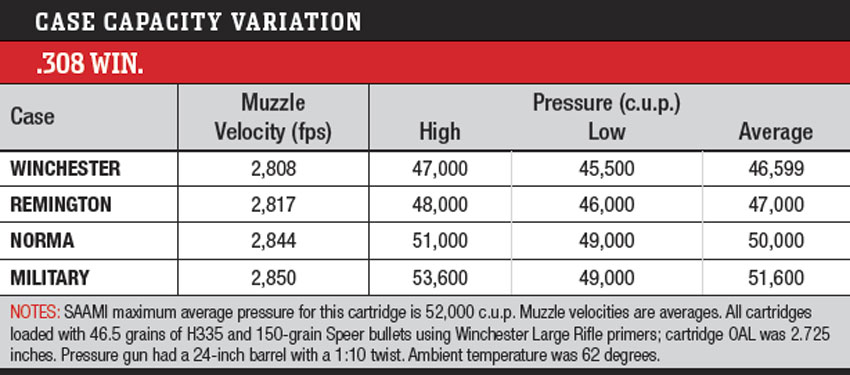
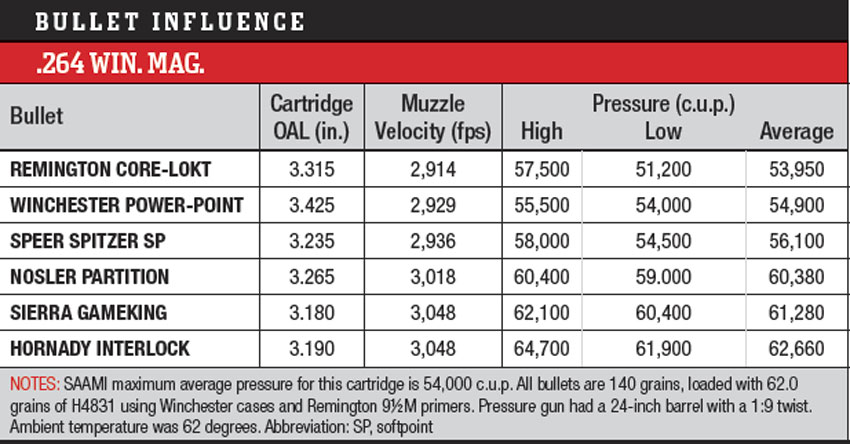
Actual chamber pressure can be influenced by many things. I've detailed a number of them in the accompanying charts - and a big "give thanks yous" to Hodgdon for generating these information for the commodity.
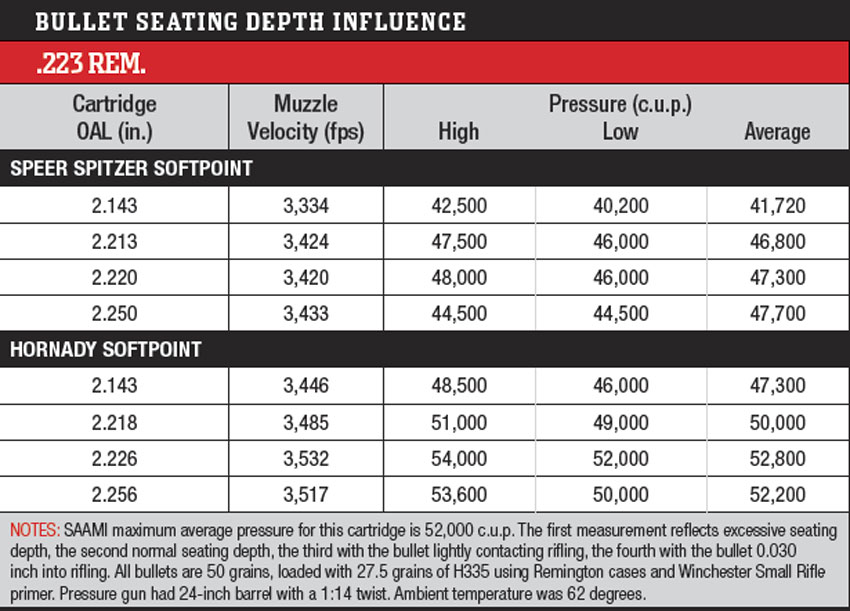
Switch from one bullet to another of the same weight but of a unlike style - or from a different maker - with pulverization type and accuse weight remaining the same and pressure level may increase, decrease or remain the aforementioned. Fire the aforementioned load in two rifles chambered for the same cartridge and pressure will exist higher in the 1 with tighter chamber and bore dimensions.
This is not a problem with factory ammo because pressure barrels used for testing are chambered and rifled to absolute minimum SAAMI dimensions. Manufacturers of mass-produced barrels are allowed to keep them inside a minimum/maximum allowable tolerance range, and while factory armament fired in the former will produce higher pressure than in the latter, it should still be at a rubber level.
The capacities of cartridge cases from various manufacturers tin can vary slightly, and that, too, has an effect on force per unit area. Switching primers tin can increase or subtract pressure level. The same applies to varying the seating depth of a bullet in the case. Allow a box of cartridges to bake under a hot sun for several hours and when fired they volition generate higher force per unit area than if left in the shade. I could probably think of a few more, but I'grand running out of space.
Hard bolt elevator is ane of the more than common signs of excessive pressure. Another is the advent of a shiny circle on the head of a case fired in a rifle with a plunger-manner ejector. And what makes it shiny? Pressure causes the brass to extrude dorsum into the ejector tunnel and when the bolt is rotated, the top of the extrusion is sheared off by a sharp edge at the oral fissure of the tunnel.
A flattened primer can be a sign of too much pressure, but it can also betoken excessive headspace. A pierced primer may indicate excessive pressure, or it could indicate its loving cup is too soft or the nose of the firing pivot is shaped improperly.
watterscomple1992.blogspot.com
Source: https://www.rifleshootermag.com/editorial/critical-factors-affecting-rifle-chamber-pressure/83492
0 Response to "what are the effects of shooting firearms to blood pressure"
Post a Comment